Almost Everything I Read in 2025
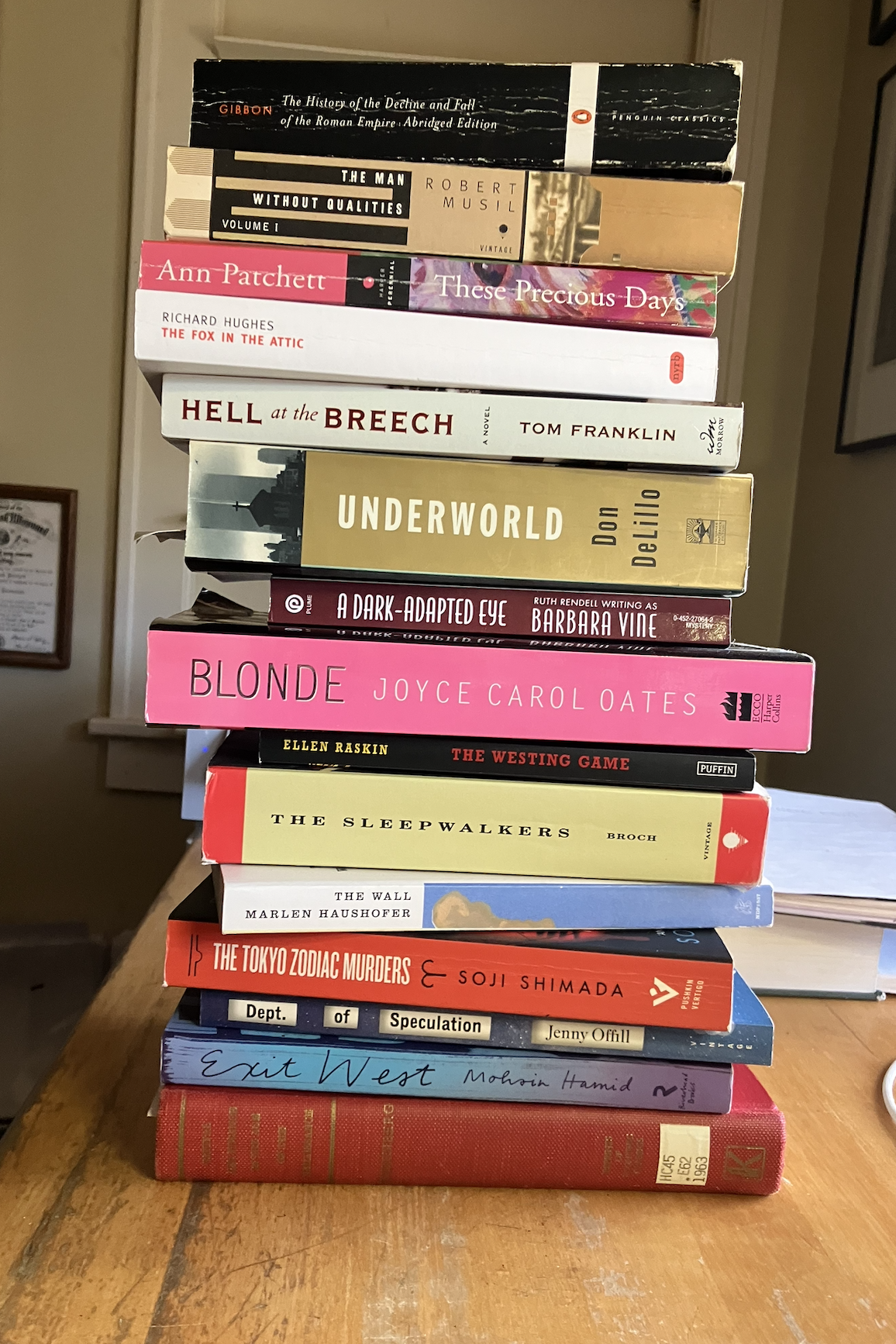
This isn't everything I read in 2025 (and I didn't finish one or two), but it's a good sampling for this newsletter, and will serve here as a kind of summing up of a strange year.
I won't bore you with every title, but -- second from the top -- Robert Musil's (1913) The Man Without Qualities is noteworthy for defeating me again on this, my second attempt, to make it through. I know it's about the social ills that landed us in WWI and I know it's important, but I can't discern its message. That doesn't mean it isn't there.
The Fox in the Attic by Richard Hughes (1961) is that rare example of a novel featuring Adolph Hitler as a character, based on Hughes' interviews with a personal acquaintance of the furor's.
Hell at the Breech by Tom Franklin (2003) is set in northern Alabama one generation after the Civil War and is based on a true story of a small gang of country-dwelling men who, looked down on by the modern world (the townies), take arms to claim the right to self-govern.
Dept of Speculation by Jenny Offill (2014) is a stunning, funny, spare account of the mental toll of a husband's affair on a heroine who just keeps wisecracking her way thru her breakdown.
Another classic here is The Sleepwalkers by Hermann Broch (1930), an interesting, long, difficult farce that lacks a hero. It tracks the collapse of society and decency in Germany after WWI. The characters who have any decency are ineffectual and the ones who can make things happen are sociopaths. That sounds familiar, actually.
Another worthwhile title, second from the bottom, is Mohsin Hamid's Exit West, an immigrant story about Saeed and Nadia, a young couple in a country overrun by militants who find a mysterious door and escape through it into a safer but more impoverished unnamed country in which they manage to locate another door which takes them to London, where they find another door that -- well, you get the idea.
At the very bottom is a research book by Richard Ehrenberg, subtitled A Study of the Fuggers and Their Connections (1928) about a Catholic moneylending dynasty that kept Europe afloat in the 15th and 16th Centuries by lending chiefly to monarchs in Spain, Italy, England, Germany and the Netherlands. The family finally became wealthier than most monarchies, then sold out and fled, barely escaping a business in which, rather than pay, the client might just hang you for treason.
The biggest surprise of the pile is Joyce Carol Oates' monumental Marilyn novel, Blonde (2003). At seven-hundred-some pages, with a demanding style, it's an undertaking. The point of view is mostly a plural first-person (a "we" that includes all of us who either met, knew, slept with, read about, watched, loved or had the merest awareness of a myth named Marilyn). But there's also a super-tight close-third-person usually i.d.'d as "the blonde actress." This vantage is a marvel of range, crafted perfectly to fit a story of somebody who was more imaginary than real.
Michiko Kakutani of the NYTBR blasted it when it appeared, maybe because it felt like an unkind thing for one woman to write about another. It could also be that even veteran novel readers are made uncomfortable by the conceits of historical fiction. But the book isn't as much a study of the person born Norma Jean Baker as it is about a fiction we made up about a blonde goddess. Oates' Marilyn behaves like a partly amoral, insane person. She is matter-of-fact about sharing herself widely in Hollywood, because sex is part of her business model, and also it's the reflexive fallback of a needy orphan. She is exploited, but her dangerous liaisons get her cast in movies.
In Blonde, Marilyn's studio name isn't real to her, and she tells everyone to keep calling her Norma. But the second identity starts to take over, and she grows confused about what is real. She also has a stammer. Her resentful co-stars suffer dozens of takes of every scene so she can spit her lines out. Off-camera, she barely holds it together, scalp and crotch burning from the constant hair-bleaching. Panic attacks paralyze her, making her hours late to the set for every shoot. Many crackpot theories have been floated about Marilyn's life and death and Oates entertains several of the wildest. But Blonde, as the title suggests, isn't about that Marilyn Monroe -- it's about someone we created from our crazed lust for blondes.
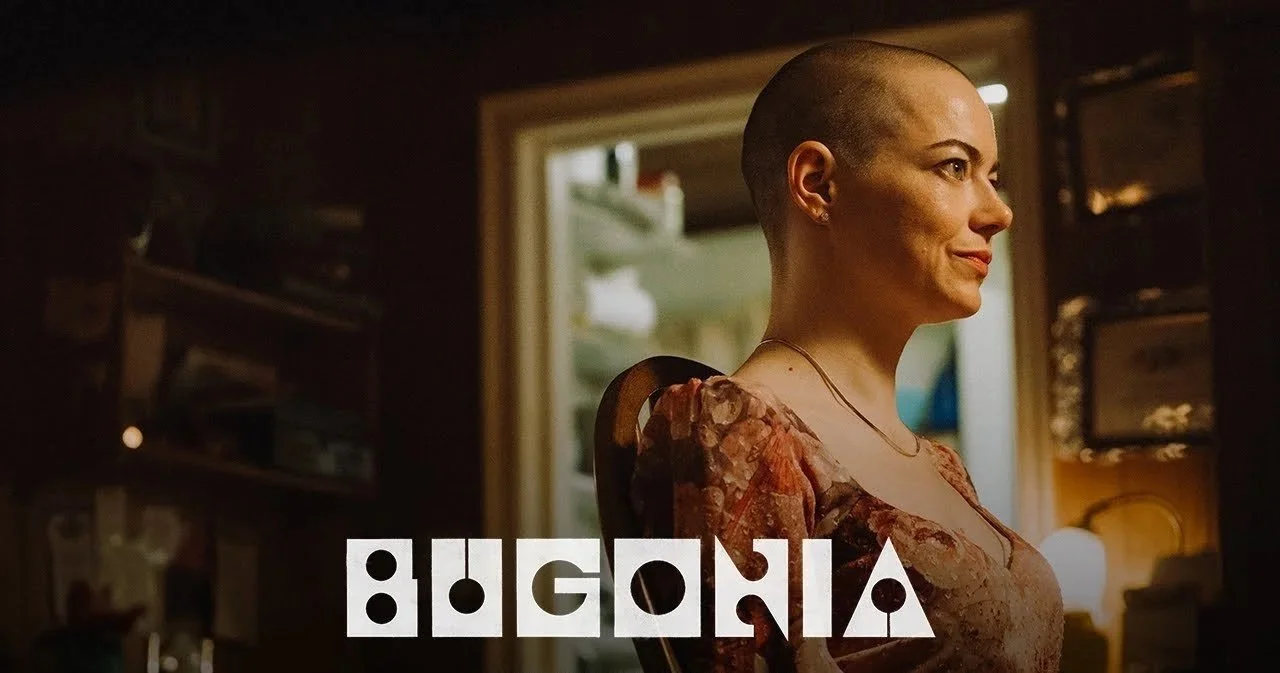
A movie I like this time is Bugonia with Emma Stone. Part of the pleasure is how unpersuasive Emma Stone is trying to convince the humans she isn't exactly what she looks like: an alien queen from the planet Andromeda.
For any new readers: My novel, Tania the Revolutionary, is available on Amazon for Kindle and paperback or Barnes & Noble for eBook.
